
The Bureau of Indian Standards (BIS) has evolved over the years to strengthen India's quality, safety, and standardisation framework.

1947: The Indian Standards Institution (ISI) was established to develop national standards and promote product quality.
1952: The ISI Certification Marks Scheme was introduced to help consumers identify products that meet prescribed quality standards.
- 1986: The Bureau of Indian Standards Act was enacted, providing the foundation for establishing BIS.
1987: BIS officially came into existence on 1 April 1987, taking over the functions of the erstwhile ISI.
2016: The Bureau of Indian Standards Act, 2016, was enacted to expand the scope of standardisation and conformity assessment.
2017: The BIS Act, 2016, came into force on 12 October 2017, introducing broader conformity assessment provisions, including multiple certification schemes and stronger consumer protection measures.
Today: BIS plays a major role in developing Indian Standards, product certification, hallmarking, testing, and ensuring the quality and safety of products across India.
The Bureau of Indian Standards (BIS) offers different certification schemes to ensure that products and services meet applicable Indian Standards.
The BIS certification process involves several steps to ensure that a product meets the applicable Indian Standards for quality, safety, and performance.
The first step is to identify the relevant Indian Standard (IS) applicable to the product. Manufacturers should also check whether BIS certification is mandatory under the relevant Quality Control Order (QCO) and determine the appropriate certification scheme.
Manufacturers must verify that their products and manufacturing facilities meet the eligibility requirements of the applicable BIS certification scheme. They should also ensure that the necessary manufacturing infrastructure, machinery, and quality-control facilities are available.
Applicants must arrange all necessary documents before submitting the BIS application. These generally include business registration certificates, manufacturing unit address proof, product specifications, manufacturing process details, machinery lists, testing equipment details, and quality-control documents.
Manufacturers need to register on the applicable BIS online portal and complete the application form with accurate product and manufacturing details. They must upload the required supporting documents and pay the applicable government fees to proceed with the application.
Product samples are tested according to the relevant Indian Standard to verify their quality, safety, and performance. Testing must be conducted through the applicable BIS-recognised laboratory or testing arrangement prescribed under the certification scheme.
Where required, BIS officials visit the manufacturing facility to inspect production infrastructure, machinery, testing equipment, and quality-control procedures. The inspection helps verify whether the manufacturer can consistently produce products that meet the applicable Indian Standards.
If any issues are identified during product testing or factory inspection, the manufacturer must take corrective action. Additional documents, product samples, or testing may be required before the certification process can proceed.
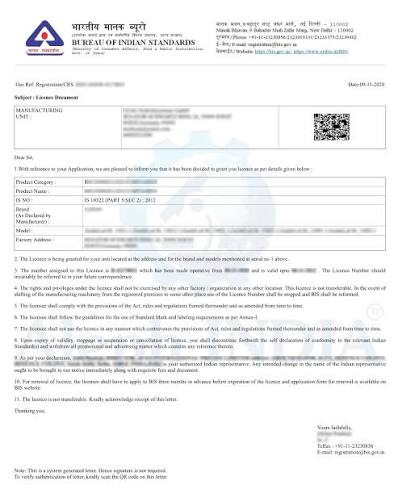
After successfully evaluating the application, product test reports, inspection findings, and other applicable requirements, BIS grants the licence, registration, or Certificate of Conformity (CoC), depending on the certification scheme.
Once certification is granted, manufacturers can use the authorised BIS Standard Mark on approved products according to the applicable marking and labelling requirements. The relevant licence or registration details must also be displayed wherever prescribed.
After obtaining BIS certification, manufacturers must continue maintaining product quality and complying with the relevant Indian Standards. They must also follow applicable BIS surveillance, inspection, testing, and licence renewal requirements to maintain certification.
Application Fee: ₹1,000
Inspection Fee: ₹7,000 per man-day
Annual Licence Fee: ₹1,000
Renewal Fee: ₹1,000
Late Renewal Fee: ₹5,000
New Variety Inclusion Fee: ₹5,000
Testing Fee: As applicable
Annual Marking Fee: Product-specific
Document Preparation: 1–2 Weeks
Application Submission: 1–2 Weeks
BIS Application Review: 2–3 Weeks
Factory Inspection: 1–2 Weeks
Product Sample Testing: 2–4 Weeks
Final Evaluation: 1–2 Weeks
Grant of BIS Licence: 1 Week
Initial BIS Licence Validity: Up to 2 Years.
Renewal Period: Up to 5 Years.
Licence Renewal: Before the expiry date.
Renewal Requirements: Compliance with BIS guidelines and payment of applicable fees.
Continuous Compliance: Manufacturers must maintain product quality and follow BIS requirements.
Licence Suspension or Cancellation: Possible in case of non-compliance with BIS regulations.
Renewal Application: Submit through the Manakonline portal.
Application Form: Form XII (Scheme I).
Application Timeline: Preferably 2 months before licence expiry.
Renewal Period: Minimum 1 year and up to 5 years.
Application Fee: ₹1,000.
Annual Licence Fee: ₹1,000.
Marking Fee: As applicable to the product.
Required Documents: Production details and applicable supporting documents.
Late Renewal Fee: ₹5,000 (FMCS).
Compliance: Maintain product quality and fulfil BIS requirements.